

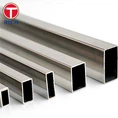


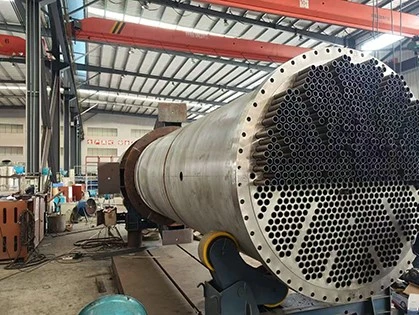
Heat exchanger tubes operating with seawater, brackish water, high-chloride cooling water, or corrosive process fluids face a constant risk of pitting, crevice corrosion, erosion, and premature leakage. In these environments, material selection can have a direct impact on equipment life and maintenance costs.
ASTM B338 Titanium Tube is specifically designed for condenser and heat exchanger service. Because titanium combines strong corrosion resistance with low density and good heat-transfer performance, titanium heat exchanger tubes are widely used in power generation, desalination, chemical processing, marine, and petrochemical equipment.
But choosing titanium is only the first step. Buyers still need to determine the correct grade, dimensions, manufacturing method, and inspection requirements.
What Is ASTM B338 Titanium Tube?
ASTM B338 is the standard specification for seamless and welded titanium and titanium-alloy tubes intended for use in condensers and heat exchangers. It covers requirements regarding material composition, mechanical properties, dimensions, manufacturing processes, and quality testing.
Unlike general-purpose titanium piping, ASTM B338 focuses specifically on tubular products designed for heat-transfer equipment.
These tubes are available in either seamless or welded forms. Seamless titanium tubes are produced from hollow billets, which are processed to their final dimensions through cold extrusion or cold drawing. Welded titanium tubes are manufactured by automatically rolling and welding titanium strips, followed by a sizing process.
In large-scale condenser and heat exchanger projects, welded tubes are more widely used due to their cost advantages and dimensional stability, whereas seamless tubes are typically reserved for high-pressure or specialized operating conditions. The selection of the appropriate type is based on the technical specifications of the equipment; it should not be assumed that seamless tubes are inherently superior.
Common ASTM B338 Titanium Grades for Heat Exchangers
The ASTM B338 standard covers 28 grades of titanium. For industrial heat exchangers, Grades 2, 7, and 12 are among the grades commonly considered because they offer different combinations of corrosion resistance, strength, and cost.
| Grade | UNS Number | Alloy Type | Key Characteristic | Typical Selection Direction |
| Grade 1 | R50250 | Commercially Pure Titanium | Highest ductility | Applications requiring extensive forming |
| Grade 2 | R50400 | Commercially Pure Titanium | Balanced corrosion resistance and strength | General heat exchanger applications |
| Grade 7 | R52400 | Titanium-Palladium Alloy | Enhanced corrosion resistance | High-chloride / low-pH corrosive media |
| Grade 12 | R53400 | Titanium-Nickel-Molybdenum Alloy | Corrosion resistance with higher strength | More demanding process conditions |
I. ASTM B338 Grade 2 – General-Purpose Heat Exchanger Grade
Grade 2, UNS R50400, is commercially pure titanium and is one of the most widely used titanium grades for industrial equipment.
It provides a practical balance of corrosion resistance, strength, ductility, weldability, and formability. It is widely used in seawater cooling, oil refining and petrochemical heat exchangers, and seawater desalination equipment.
For many seawater-cooled condensers and shell-and-tube heat exchangers, ASTM B338 Grade 2 titanium tube is therefore a common starting point.
II. ASTM B338 Grade 7 – For More Aggressive Corrosion
Grade 7, UNS R52400, is based on commercially pure titanium with a small palladium addition.
The palladium improves corrosion resistance under certain reducing conditions. Grade 7 is particularly useful where chloride exposure is combined with low pH or where crevice corrosion resistance needs to be improved.
Therefore, when the medium is an acidic chlorine-containing fluid and ordinary Grade 2 will corrode, engineers usually choose Grade 7.
III. ASTM B338 Grade 12 – Corrosion Resistance with Higher Strength
Grade 12 (UNS R53400) contains small additions of nickel and molybdenum, with a nominal composition of approximately 0.6–0.9% nickel and 0.2–0.4% molybdenum.
These additions enhance strength and crevice corrosion resistance while maintaining good weldability. It offers superior resistance to crevice corrosion and reducing acids than Grade 2-approaching Grade 7 performance in many media-but at a lower cost. Grade 12 is used in applications such as shell-and-tube heat exchangers and chemical-processing equipment.
ASTM B338 Titanium Tube Sizes and Dimensions
The dimensions of ASTM B338 titanium tubes are normally specified by outside diameter (OD), wall thickness (WT), and length. A typical specification may be written as:
19.05 mm OD × 0.7 mm WT × 6,000 mm length
For condenser and heat exchanger applications, commonly used outside diameters include 12.7 mm, 19.05 mm, and 25.4 mm. However, these are only typical examples. The actual tube size should be determined by the heat exchanger design, operating pressure, required heat-transfer area, tube-sheet layout, and project specification.
Dimensional consistency is especially important for titanium heat exchanger tubes. Excessive OD variation can affect tube-to-tubesheet expansion and assembly, while inconsistent wall thickness may influence pressure resistance and heat-transfer performance.
When placing an order, buyers should clearly specify the required OD tolerance, wall thickness tolerance, cut length, straightness, and tube-end condition according to the equipment drawing or project requirements. For custom heat exchanger projects, tube dimensions can also be supplied to match specific bundle and tubesheet designs.
Typical Titanium Heat Exchanger Tube Applications
ASTM B338 titanium tubing is commonly used in the following applications:
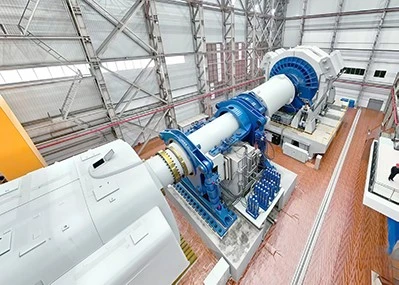
Power Plant Condensers
Titanium tubes are widely used in condensers where seawater, brackish water, or high-chloride cooling water can increase the risk of corrosion.
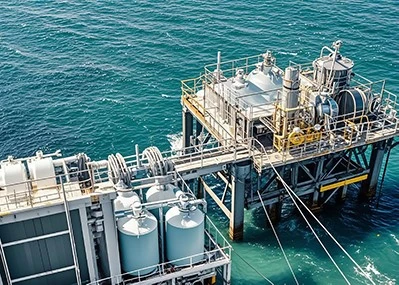
Marine and Desalination Heat Exchangers
In marine, offshore, coastal, and desalination systems, titanium heat exchanger tubes are selected for their resistance to seawater corrosion and erosion.
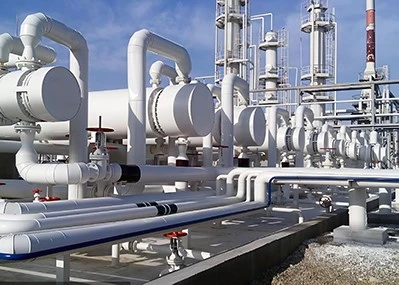
Chemical Processing Heat Exchangers
Titanium tubing is suitable for heat exchangers handling corrosive process fluids where conventional stainless steels may not provide sufficient service life.
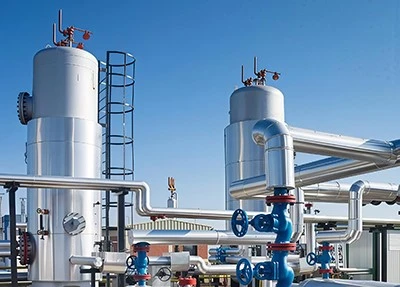
Refinery and Petrochemical Equipment
Titanium tubes are used in selected refinery and petrochemical heat exchangers where cooling-water chemistry, chlorides, and process conditions require higher corrosion resistance.
How to Select the Right ASTM B338 Titanium Tube
I. Selecting the Titanium Grade Based on the Medium
First, identify the cooling medium and the process fluid. For seawater or neutral chloride-containing media, Grade 2 is the preferred choice. In acidic, reducing environments containing chloride ions, Grade 7 should be used. For process conditions requiring higher strength, consider Grade 12.
II. Choosing Between Seamless and Welded Tubes
Follow equipment specifications and pressure rating requirements. Welded tubes are commonly used for large-scale tube bundle projects, while seamless tubes are generally selected for high-pressure or specialized operating conditions.
III. Verifying Compatibility Between Tubes and Tubesheets
When titanium tubes are expanded or welded into tubesheets made of dissimilar metals, careful attention must be paid to galvanic corrosion and joint design-a critical technical aspect that is frequently overlooked by purchasers.
TORICH supplies ASTM B338 Titanium Tube for condenser and heat exchanger applications, including different titanium grades and customized OD, wall thickness, and length requirements.
For projects involving seawater, chlorides, chemical media, or demanding heat exchanger service, send us your grade, OD × WT × length, quantity, operating medium, temperature, pressure, and required testing. Our team can support specification review and quotation for your titanium heat exchanger tube project.