

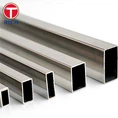


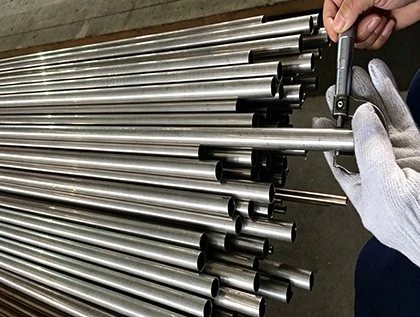
Choosing the right copper nickel tube is essential for the long-term performance of seawater heat exchangers, condensers, and marine cooling systems. Two widely used grades are C70600 copper nickel tube (90/10 Cu-Ni) and C71500 copper nickel tube (70/30 Cu-Ni).
Both offer excellent seawater corrosion resistance, but they differ in nickel content, mechanical strength, thermal conductivity, and resistance to high-velocity seawater. Understanding these differences helps engineers and procurement teams select the appropriate material for their operating conditions.
What Are C70600 and C71500 Copper Nickel Tubes?
I. C70600 Copper Nickel Tube (90/10 Cu-Ni)
C70600 is a copper nickel alloy containing approximately 90% copper and 10% nickel, with small additions of iron and manganese to improve corrosion resistance.
It offers good thermal conductivity, reliable seawater corrosion resistance, and relatively economical material costs. These characteristics make C70600 copper nickel tubes widely used in marine condensers, seawater cooling systems, and industrial heat exchangers.
II. C71500 Copper Nickel Tube (70/30 Cu-Ni)
C71500 contains approximately 70% copper and 30% nickel, along with controlled amounts of iron and manganese.
Compared with C70600, C71500 copper nickel tubes generally provide higher mechanical strength and better resistance to erosion-corrosion under higher seawater flow velocities. They are commonly selected for demanding marine, offshore, and industrial heat exchange applications.
C70600 vs C71500: Chemical Composition and Properties
The difference in chemical composition between the two lies primarily in their nickel and iron content: C70600 compensates for its lower nickel content with a higher iron concentration (1.0–1.8%) to ensure corrosion resistance, whereas C71500 relies on a high nickel content as the primary factor for its strength and resistance to erosion.
I. Chemical Composition Comparison
| Element | C70600 (90/10) | C71500 (70/30) |
|---|---|---|
| Copper (Cu) | Balance | Balance |
| Nickel (Ni) | 9–11% | 29–33% |
| Iron (Fe) | 1.0–1.8% | 0.4–1.0% |
| Manganese (Mn) | ≤1.0% | ≤1.0% |
These are commonly referenced composition ranges. Final chemical requirements should follow the applicable material specification.
II. Mechanical and Physical Properties
| Property | C70600 | C71500 |
|---|---|---|
| Tensile Strength | 300 MPa | 350 MPa |
| 0.2% Proof Strength | 100 MPa | 120 MPa |
| Elongation | 30% | 35% |
| Thermal Conductivity | 50 W/m·K | 29 W/m·K |
| Density | 8.90 g/cm³ | 8.95 g/cm³ |
Mechanical values are typical reference values for annealed material, not guaranteed specifications for every tube condition.
C71500 offers higher mechanical strength, while C70600 provides better thermal conductivity. However, overall heat exchanger efficiency also depends on tube wall thickness, fluid conditions, fouling resistance, and equipment design.
Corrosion Resistance and Seawater Performance
I. Seawater Corrosion Resistance
Both C70600 and C71500 develop protective surface films that help resist corrosion in seawater environments.
Their established resistance to seawater corrosion makes them suitable for condensers and marine cooling systems. However, long-term performance depends on water quality, dissolved oxygen, pollution, operating temperature, and maintenance conditions.
A higher nickel content does not automatically make C71500 the better choice for every seawater application.
II. Flow Velocity and Erosion-Corrosion Resistance
Seawater velocity is an important factor when selecting copper nickel heat exchanger tubes.Excessive flow velocity, particularly near tube entrances or areas of turbulence, can damage protective films and increase erosion-corrosion risks.
The following typical maximum velocity guidelines illustrate the difference between the two grades:
| Heat Exchanger Design | C70600 | C71500 |
|---|---|---|
| Once-through | 2.4 m/s | 3.0 m/s |
| Two-pass | 2.0 m/s | 2.6 m/s |
These values are general design guidelines rather than universal operating limits. Actual permissible velocities depend on system geometry, seawater quality, and operating conditions. C71500 generally provides greater flexibility for higher-velocity seawater systems.
Applications of C70600 and C71500 Copper Nickel Tubes
I. Marine Heat Exchangers and Condensers
Copper nickel tubes are widely used in shipboard condensers and seawater heat exchangers. C70600 is often suitable for conventional cooling conditions, while C71500 may be preferred where higher seawater velocities are required.
II. Power Plant Cooling Systems
Power plants use copper nickel tubing in surface condensers, water coolers, and auxiliary heat exchangers. Material selection depends on cooling water chemistry, flow velocity, and equipment design requirements.
III. Desalination and Seawater Treatment
Copper nickel alloys are used in seawater desalination systems, including heat recovery, heat rejection, and brine heating equipment. Operating temperature, salinity, and flow conditions influence grade selection.
IV. Offshore and Petrochemical Equipment
Offshore platforms and petrochemical facilities use copper nickel tubes in process coolers, condensers, and seawater cooling equipment where corrosion resistance and dependable heat transfer are important.
How to Choose Between C70600 and C71500?
The better material depends on the actual operating conditions rather than nickel content alone.
| Selection Factor | Recommended Grade |
| Higher thermal conductivity | C70600 |
| Standard seawater cooling conditions | C70600 |
| Higher seawater flow velocity | C71500 |
| Higher mechanical strength requirements | C71500 |
| Lower initial material cost | Consider C70600 first |
TORICH C70600 and C71500 Copper Nickel Tube Supply
TORICH supplies C70600 (90/10) and C71500 (70/30) copper nickel tubes for marine cooling systems, condensers, and industrial heat exchanger applications.
ASTM B111/B111M covers seamless copper and copper-alloy condenser tubes, including these two grades.
When requesting a quotation, please provide the required material grade, outside diameter (OD), wall thickness (WT), tube length, quantity, and applicable technical specifications.
TORICH supports project-specific tube requirements, helping customers evaluate suitable materials and dimensions based on their equipment applications.
Frequently Asked Questions
Q: What is the main difference between C70600 and C71500?
A: C70600 contains approximately 10% nickel, while C71500 contains approximately 30%. C71500 generally offers higher mechanical strength, whereas C70600 provides better thermal conductivity.
Q: Is C71500 more corrosion-resistant than C70600?
A: Both grades have good seawater corrosion resistance. C71500 generally offers better resistance to erosion-corrosion at higher flow velocities, but actual performance depends on operating conditions.
Q: Which copper nickel tube is better for seawater heat exchangers?
A: C70600 is a practical choice for many conventional seawater heat exchangers. C71500 may be more suitable where higher seawater velocities or additional mechanical strength are required.
Q: Can C70600 and C71500 be used interchangeably?
A: Not automatically. Substitution requires verification of mechanical properties, thermal performance, corrosion conditions, and equipment design requirements.