

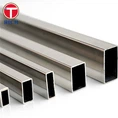


When engineers or buyers compare ERW Tubing vs DOM Tubing, the key question is not simply "which one is better?" The real issue is whether the final part needs the extra dimensional control created by cold drawing.
Most DOM tubing starts as ERW tubing and then goes through an additional drawing process over a mandrel. Understanding that difference helps buyers choose the right tube without paying for precision the application does not actually need.
What Is ERW Tubing?
ERW stands for Electric Resistance Welded tubing; it is a standard welded steel pipe used across industries and serves as a primary base material for mechanical structural tubing. Its core production process is streamlined and efficient-comprising steel strip uncoiling, roll forming, high-frequency resistance welding, weld bead trimming, and sizing/cutting-without requiring secondary cold-drawing or finishing steps, making it a highly cost-effective, general-purpose tubular product.
I. Weld Characteristics
ERW steel pipes feature a fixed longitudinal weld. During production, the external weld bead is ground off to ensure a smooth, clean outer surface; however, the internal weld bead is typically left intact or only minimally trimmed, with the specific finish adjusted according to specifications and order requirements. This characteristic results in limited internal roundness and wall uniformity; consequently, if used for sleeves, bushings, or precision-fit components, assembly accuracy and operational stability may be compromised.
II. Dimensional Accuracy
While the consistency of the outer diameter and wall thickness of standard ERW steel pipes meets general structural requirements-with tolerances falling within industry-standard limits-the absence of cold-drawing calibration results in inherent deviations regarding roundness, concentricity, and wall thickness uniformity. Therefore, they are unsuitable for applications requiring high-precision assembly or precision machining.
III. Common Applications of ERW Tubing
The core advantage of ERW steel pipes is their cost-effectiveness and practicality, making them the preferred choice for applications that do not demand stringent dimensional accuracy or precision internal-fit tolerances. Typical applications include equipment supports, framework structures, general mechanical components, agricultural equipment frames, general hardware components, and standard automotive structural parts.
What Is DOM Tubing?
DOM (Drawn Over Mandrel) steel tubing is a precision-finished product derived from ERW (Electric Resistance Welded) tubing; it is not seamless steel tubing-a key distinction that is frequently misunderstood in the industry. It is typically produced by taking ERW tubing as the base material and subjecting it to a cold-drawing process using a die and a mandrel.
I. DOM Steel Tube Manufacturing Process
ERW base tube → Heat treatment (annealing) as required → Cold drawing with dies → Precision sizing over a mandrel → Straightening and shaping → Surface finishing → Inspection and dispatch. Compared to standard ERW steel tubes, the key addition of the mandrel cold-drawing process fundamentally optimizes the tube's core parameters.
II. Weld Seam Characteristics
DOM steel tubes are not seamless; the base material retains an ERW longitudinal weld seam. However, through the combined effects of mandrel cold drawing, heat treatment, and finishing processes, the microstructure in the weld zone is refined and homogenized. Dimensional variations and structural defects at the weld are virtually eliminated, making the weld location nearly indistinguishable to the naked eye or during standard inspections, while significantly enhancing the overall uniformity of the tube.
III. DOM Tube Applications
DOM precision steel tubes are designed for precision machining and functional assembly applications. They are primarily used for precision automotive components (chassis parts, roll cages, transmission sleeves, shock absorber components), hydraulic and pneumatic system piping, precision machinery bushings and sleeves, precision rollers, precision frames for automation equipment, high-end agricultural machinery parts, and precision load-bearing components for construction machinery.
Key Differences Between ERW and DOM Tubing
The most useful way to compare ERW Tubing vs DOM Tubing is to look at what the finished component actually requires.
|
Comparison Dimension |
ERW Tubing |
DOM Tubing |
|
Manufacturing Process |
Strip forming + electric resistance welding, no secondary cold drawing |
ERW mother tube + over-mandrel cold drawing + heat treatment + precision finishing |
|
Weld Condition |
Visible internal & external welds, internal weld flash commonly retained |
Original weld zone refined and smoothed, no obvious weld defects |
|
Dimensional Tolerance |
Standard commercial tolerance, general precision |
Strict high-precision tolerance for precision fitting |
|
OD / ID Concentricity |
Standard control with noticeable deviation |
Tightly controlled, excellent concentricity |
|
Internal Surface Condition |
Possible weld flash and uneven surface |
Smooth, uniform and defect-free inner wall |
|
Mechanical Strength |
Dependent on steel grade, stable performance |
Cold-work strengthened, improved yield & tensile strength |
|
Machinability |
Suitable for general cutting, welding and rough machining |
Excellent for precision turning, honing and tight-tolerance assembly |
|
Cost |
Low cost, high cost-performance |
Higher unit price due to additional processing procedures |
|
Typical Applications |
General structures, supports, conventional mechanical parts |
Precision machinery, hydraulic components, automotive critical parts |
What people also ask for ERW tubing and DOM tubing?
I. Is DOM Tubing Stronger Than ERW Tubing?
It's not a simple matter of generalization. DOM steel pipes, through cold drawing, refine the steel's microstructure, resulting in higher yield and tensile strength than ordinary ERW steel pipes under the same material and heat-treatment conditions. However, the final strength of the pipe depends on the steel grade (1020, 1026, 4130, etc.), the quality of the base material, the amount of cold drawing, and the final heat-treatment state.
Simply put: DOM represents an upgraded precision machining process, not a higher grade of steel. Strength cannot be judged solely based on material and processing conditions.
II. Which Has Better Dimensional Accuracy?
DOM steel pipes lead in overall precision. Utilizing a mandrel cold-drawing finishing process, its inner and outer diameter tolerances, wall thickness uniformity, roundness, and coaxiality are all precisely controlled, resulting in a smooth inner surface free of weld defects.
In applications such as bushings, sleeves, hydraulic fittings, and precision shafts, DOM (Determined Osmosis) steel pipes can significantly reduce subsequent machining allowances such as boring, honing, and shaping, lowering finishing costs and scrap rates. ERW (Extended Eroded Wrap) steel pipes, on the other hand, have more internal diameter deviations and surface defects, and are only suitable for structures that do not require a precision fit.
III. Which Is Better for Bending and Fabrication?
A common misconception is that DOM, with its higher precision and quality, is more suitable for all bending scenarios. This is not the case.
After cold drawing, DOM steel pipes exhibit increased hardness and yield strength, slightly decreased elongation, and altered resilience. The bending effect of the pipe depends primarily on the pipe diameter, wall thickness, bending radius, steel grade, and heat treatment state, not simply on the difference between ERW and DOM processes.
Therefore, buyers planning bending, welding, or forming operations should evaluate the complete process route rather than selecting tubing based solely on the manufacturing name.
How to choose: ERW Tubing And DOM Tubing?
I. When Should You Choose ERW Tubing?
- No strict dimensional tolerance requirements; used primarily for load-bearing or framework structures
- The inner wall is not a functional working surface; no need for a smooth, precision fit
- No subsequent precision finishing processes required; only simple cutting and welding/forming
- Project budget is a priority; focus on cost-effectiveness
- Typical applications include: frames, brackets, supports, and general structural components
II. When Should You Choose DOM Tubing?
- Strict precision requirements for inner/outer diameter tolerances, wall thickness uniformity, and concentricity
- The inner wall is a critical functional surface requiring smoothness, flatness, and a tight fit
- Requires precision finishing processes such as turning and honing; aims for minimal machining allowance and low scrap rates
- Used in critical applications such as automotive parts, hydraulic components, precision machinery, chassis roll cages, and precision agricultural equipment