

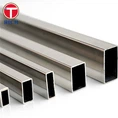


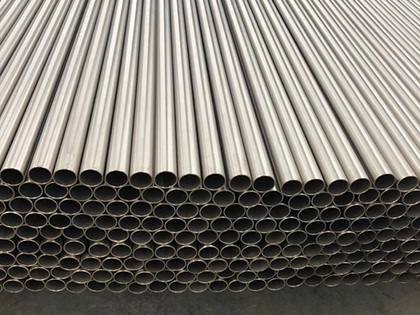
For the majority of heat exchanger applications, Grade 2 titanium (commercially pure titanium) and Grade 5 titanium (Ti-6Al-4V) represent the most suitable choices. Titanium alloy tubes manufactured from Grade 2 titanium exhibit excellent corrosion resistance, with sufficient strength to satisfy the demands of most chemical processing and marine environments; Grade 5 titanium, conversely, offers superior mechanical strength, making it ideal for high-pressure operating conditions or compact system designs. Selecting the appropriate titanium alloy tubing requires a careful balance between the tube type (seamless or welded), the specific alloy grade, and the actual operating conditions.
Why Use Titanium Alloy Tubes?
I. Applications of Titanium Alloys in Heat Exchangers
Titanium alloy tubes are widely utilized in heat exchangers across various industries, including chemical processing, marine engineering, power generation, and seawater desalination.
In the petrochemical industry, titanium alloy tubes are employed in heat exchange systems involving corrosive media-such as those handling sulfuric or hydrochloric acid-where their exceptional corrosion resistance ensures the long-term, stable operation of the system.
In marine heat exchangers, titanium alloy tubes effectively withstand seawater corrosion while preventing scaling and material degradation, thereby extending the service life of the equipment.
In power plant condensers and seawater desalination facilities, the high heat transfer efficiency and durability of titanium alloy tubes are critical to ensuring continuous equipment operation.
In geothermal power generation, titanium heat exchangers are capable of withstanding high-temperature and high-pressure media; furthermore, in vanadium redox flow batteries, they serve to maintain the electrolyte temperature within the optimal range of 10–40°C, thereby safeguarding battery efficiency.
II. Key Benefits Over Other Materials
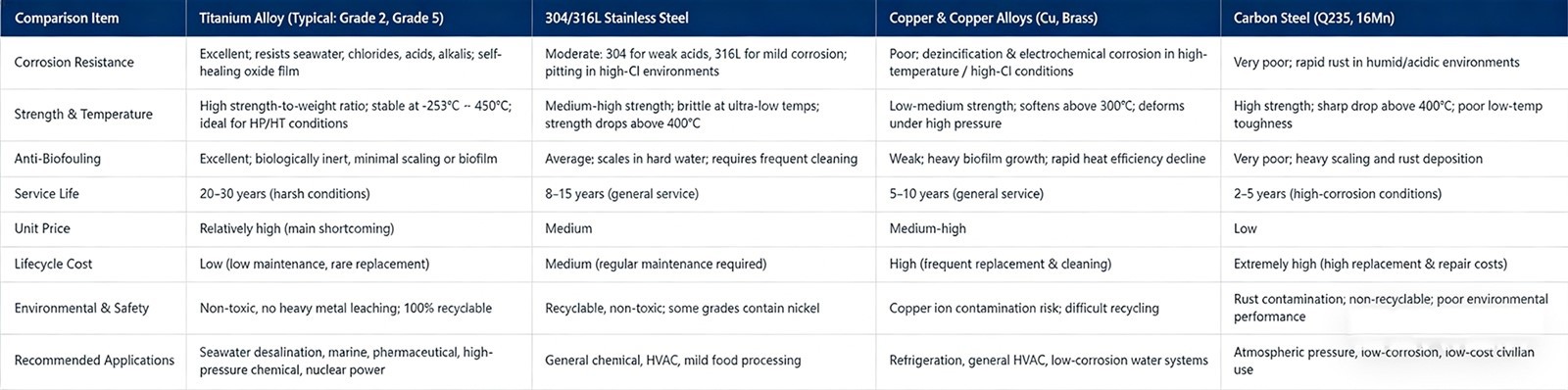
Compared to common materials such as stainless steel, copper, and carbon steel, titanium alloy tubes offer significant advantages.
First is their corrosion resistance: titanium forms a dense titanium dioxide (TiO₂) oxide film on its surface, which effectively insulates it against corrosion caused by acids, alkalis, salts, and chloride ions.
In environments containing hydrochloric acid at concentrations of 3% or less, the annual corrosion rate of titanium remains below 0.01 mm, allowing equipment to achieve a service life of over 15 years. In the chlor-alkali industry, titanium heat exchangers demonstrate resistance to corrosion from wet chlorine gas, with an annual corrosion rate similarly remaining below 0.01 mm, a performance significantly superior to that of 316L stainless steel.
Second is titanium's thermal conductivity: titanium heat exchangers exhibit a heat transfer coefficient that is 35% to 40% higher than that of traditional equipment. Their heat transfer coefficient can reach 14,000 W/(m²·℃), meaning their heat exchange capacity per unit area is 3 to 7 times greater than that of traditional equipment.
Selecting a Titanium Alloy Tube: Key Factors
I. Seamless vs. Welded Tubes
The choice between seamless and welded titanium alloy tubes depends on specific project requirements, pressure conditions, and cost considerations.
Seamless titanium alloy tubes are integrally formed through processes such as piercing, hot rolling, and drawing; they feature no weld seams, possess uniform mechanical properties, and offer strong pressure-bearing capabilities. Consequently, they are well-suited for high-pressure, high-temperature, and highly corrosive environments-such as heat exchangers in nuclear power plants and high-pressure chemical systems-though their production costs are higher, and their flexibility regarding custom sizing is limited.
Welded titanium alloy tubes are manufactured by rolling titanium plates into cylindrical shapes and subsequently welding them together. They offer greater flexibility in sizing (allowing for larger diameters and longer lengths) and come at a lower cost. These tubes perform effectively in medium-pressure and non-extremely corrosive environments-such as standard marine heat exchangers and industrial cooling systems-though strict control over welding quality is essential to prevent the weld seams from becoming vulnerable points susceptible to corrosion.
II. Choose the Right Grade
Selecting the appropriate grade of titanium alloy tubing is central to ensuring the performance of a heat exchanger.
- Grade 1 titanium tubing offers the highest corrosion resistance but the lowest mechanical strength, making it suitable for highly corrosive, low-pressure environments (such as seawater desalination systems).
- Grade 2 titanium tubing is the most widely utilized grade; it strikes an optimal balance between corrosion resistance and mechanical properties, complies with the ASTM B338 standard, and is suitable for the majority of standard heat exchangers across industries such as chemical processing, marine engineering, and power generation.
- Grade 5 titanium tubing (Ti-6Al-4V) is a high-strength alloy characterized by exceptional tensile and yield strengths. It is well-suited for high-pressure, high-temperature, and high-stress applications-such as heat exchangers in the aerospace sector or high-pressure chemical reactors-though its corrosion resistance is slightly lower than that of Grade 2, and its cost is higher.
In over 70% of industrial heat exchanger projects, Grade 2 remains the preferred choice due to its superior cost-effectiveness and corrosion resistance.
III. Mechanical Properties and Pressure Need
The mechanical properties of titanium alloy tubes must be compatible with the operating pressure and temperature of the heat exchanger. The mechanical properties and pressure compatibility requirements vary significantly across different grades of titanium alloys; a specific comparison is presented in the table below.
|
Steel Grade |
Tensile Strength |
Yield Strength |
Elongation |
Applicable Pressure Range |
Applicable Temperature Range |
|---|---|---|---|---|---|
|
Grade 1 |
240-370 MPa |
≥170 MPa |
≥24% |
Low Pressure (≤1.6MPa) |
-253℃~400℃ |
|
Grade 2 |
340-410 MPa |
≥165 MPa |
≥20% |
Medium-Low Pressure (≤4.0MPa) |
-253℃~450℃ |
|
Grade 5 |
≥895 MPa |
≥825 MPa |
≥10% |
High Pressure (>4.0MPa) |
-269℃~400℃ |
IV. Cost and Compliance
Cost is a critical practical factor when selecting titanium alloy tubes. Typically, welded titanium alloy tubes are 20% to 30% less expensive than seamless ones, making them suitable for large-scale, medium-pressure projects.
In terms of grades, Grade 2 titanium alloy tubes are more cost-effective than Grade 5. While Grade 7 titanium alloy tubes incur higher costs due to the inclusion of precious metal additives, they offer superior corrosion resistance in specialized environments.
Ensuring regulatory compliance is also paramount: ASTM B338 serves as the core standard for titanium alloy tubes used in condensers and heat exchangers, covering 28 grades of titanium and titanium alloys; ISO 18487-1 and DIN EN 3120 are also widely referenced in various regions. Compliance guarantees that the titanium alloy tubes meet established quality and safety requirements, thereby mitigating operational risks and potential losses stemming from material non-compliance.
Conclusion
In summary, Grades 2 and 5 are the top choices for heat exchangers: Grade 2 for general use with balanced performance and cost, and Grade 5 for high-pressure and high-temperature conditions. Select based on tube type, operating requirements, dimensions, and overall cost vs. compliance.