

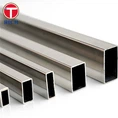


Products Description
Product Specifications
| Standards | ASTM A213 / ASME SA213 |
| Steel Grades | TP321 (UNS S32100),or TP201 TP202 TP304 TP304L TP304H TP309S TP309H TP310S TP316 TP316L TP317 TP347 TP347H TP348 TP348H TP444,etc. |
| Equivalent Standards | ASTM A269, ASTM A511, EN 10216-5, JIS G3463 |
| Outer Diameter (OD) | 6 mm – 630 mm |
| Wall Thickness (WT) | 0.5 mm – 55 mm |
| Length |
3m / 6m / 12m, customized |
| Surface Treatment | Bright Annealed (BA), Pickled & Passivated, Polished |
| Production Process | Cold drawn/ Cold Rolled |
| Condition |
Solution Annealed |
Temperatures in the exhaust pipe near the turbocharger outlet can soar to between 800°C and 950°C. At 600°C, the yield strength of Grade 321 stainless steel reaches approximately 130 MPa-more than 40% higher than the ~90 MPa of typical Grade 304-thereby significantly extending the thermal fatigue life of the exhaust manifold.
Grade 321 stainless seamless steel exhaust tubing offers excellent resistance to intergranular corrosion, eliminating the need for post-weld solution treatment. Furthermore, the dense chromium oxide layer that forms on the surface at high temperatures effectively resists corrosion from oxygen, water vapor, and trace corrosive gases in high-temperature exhaust fumes.
Customized Services
- TORICH offers precision cutting and end-processing services with tolerances controlled within ±0.2mm, including plain ends, internal and external chamfering, beveling (30°/37.5° welding bevels), and end forming (flaring and swaging).
- We provide CNC tube bending and forming services, supporting special shapes such as U-bends, serpentine coils, and spiral coils.
- Surface treatment options include pickling and passivation, bright annealing, manual mirror polishing (200#–600# grit, Ra ≤ 0.4μm), and electropolishing.
Chemical Composition
| Grade | C (max) | Cr | Ni | Mn | Si | Ti | P (max) | S (max) |
| 321 | 0.08 | 17.0–19.0 | 9.0–12.0 | ≤2.0 | ≤1.0 | ≥5×C | 0.045 | 0.030 |
| 201 | 0.15 | 16.0–18.0 | 3.5–5.5 | 5.5–7.5 | ≤1.0 | – | 0.060 | 0.030 |
| 309S | 0.08 | 22.0–24.0 | 12.0–15.0 | ≤2.0 | ≤1.0 | – | 0.045 | 0.030 |
Mechanical Properties
| Grade | Tensile Strength (MPa) | Yield Strength (MPa) | Elongation (%) | Hardness (HRB) |
| 321 | ≥ 515 | ≥ 205 | ≥ 35 | ≤ 95 |
| 201 | ≥ 520 | ≥ 275 | ≥ 40 | ≤ 100 |
| 309S | ≥ 620 | ≥ 310 | ≥ 40 | ≤ 95 |
Possible Alternative Grades
- For exhaust system sections located primarily in the middle to rear of the vehicle, where long-term operating temperatures do not exceed 600°C, 304/304L stainless steel is a suitable choice as it is more cost-effective than 321.
- For mass-produced components such as exhaust pipes, catalytic converter housings, mufflers, and diesel engine exhaust parts, 409 stainless steel is a viable option due to its lower cost and good oxidation resistance.
- For tailpipe sections frequently exposed to saline de-icing agents or humid coastal environments, 316L stainless steel is recommended, as it offers superior pitting corrosion resistance compared to 321.
applications
- Turbocharged vehicle exhaust systems: turbocharger outlet pipes, turbine exhaust pipes, hot-side intercooler exhaust ports
- High-performance and sports car exhaust systems: exhaust tailpipes, split pipes, high-performance exhaust manifolds, etc.
- Exhaust manifold systems: exhaust manifold runners, collectors, manifold connecting pipes
- Passenger vehicle exhaust systems: front exhaust pipes, intermediate pipes, catalytic converter connecting pipes
- Diesel engine exhaust systems: diesel tailpipes, high-emission-standard exhaust system piping, after-treatment connecting pipes
Products Show


Testing Equipment


Factory Equipment

Pickling equipment


Products Package


FAQ
Q: What are the fundamental differences between ASTM A213 TP321 and the decorative 304 exhaust pipes found on the market?
A: Type 304 pipes are primarily used for tail sections or aesthetic purposes; they possess low high-temperature strength and are susceptible to intergranular corrosion after welding. In contrast, A213 TP321 is used for pre-turbo sections exposed to temperatures approaching 1,000°C; it resists post-weld corrosion and offers over 40% higher long-term strength.
Q: Can 321 stainless steel exhaust pipes be bent?
A: Yes. 321 stainless steel exhibits good ductility (elongation ≥35%), making it suitable for cold bending.
Q: What is the maximum continuous operating temperature for this pipe?
A: The recommended continuous operating temperature for 321 stainless steel (in terms of oxidation resistance) is 816°C, with intermittent service up to 870°C. It demonstrates excellent creep strength and thermal fatigue life within the 600–750°C range typical of exhaust manifolds.
Hot Tags: 321 stainless seamless steel exhaust tubing, China, suppliers, manufacturers, factory, customized, wholesale, price, OEM, mill, producer, for sale, 316 stainless steel tubing polished, tp304l stainless steel pipe, sa 249 tp316l


